魂
Patient with both legs severed at thigh level walks again after doctors perform rare replantation surgery in East China’s Jiangsu_我的网站

一 |
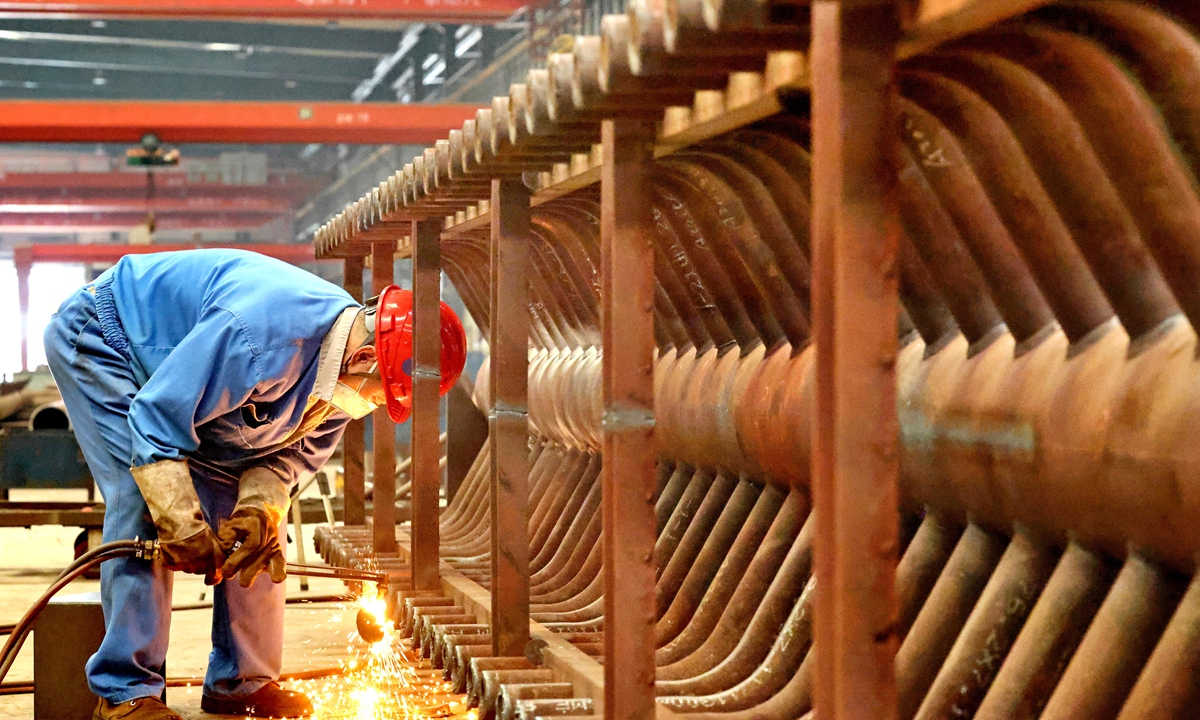
A worker fulfills orders for energy-saving and environmentally friendly boilers destined for export in a manufacturing enterprise in Nantong, East China's Jiangsu Province on August 4, 2026. The enterprise offers products including industrial waste disposal equipment, with sales to more than 30 countries and regions. Photo: CNS PhotoIn recent years, some economies, anxious about their own industrial competitiveness and market position, have politicized economic and trade issues, taking turns to hype false narratives such as "China overcapacity" and a "China Shock 2.0," and using them as pretexts to roll out protectionist measures.
But what are the facts on the ground?
China's Ministry of Commerce recently released a document titled China's Position on the So-Called Excess Capacity Issue. Reviewing the evolution of the global capacity landscape from a historical perspective, it offers an objective analysis of how industrial subsidies, trade surpluses, economic imbalances and market competition relate to "overcapacity," sets out China's policy practices and the direction of its efforts, and puts forward China's ideas and proposals - a forceful response to the "China overcapacity" narrative.
Plainly, the argument that "China's inadequate domestic demand gives rise to excess capacity" rests on a logical sleight of hand - it takes a localized phenomenon at the micro level of the market and applies it wholesale to the structure of the macroeconomy, a picture far removed from reality.
China is not only a major manufacturing power but also a major consuming power. Domestic demand has long been the main engine of the Chinese economy.
To see through the logical fallacy of the "overcapacity" narrative, one must first be clear about where the Chinese economy actually sits in the global landscape.
In the course of economic globalization, China has actively integrated itself into the international division of industrial labor and become the "world's factory" in the truest sense. Chinese manufacturing has enriched the global supply of goods, lowered living costs for consumers in countries around the world, and played an important part in easing global inflationary pressure. But to define China simply as a "producer" on that basis, and from there to conclude that it suffers from "inadequate domestic demand and overcapacity," is a proposition that does not hold water.
From 2013 to 2024, domestic demand contributed an average of 93 percent to China's economic growth, with consumption and investment accounting for an average of 55 percent and 38 percent respectively. China's total retail sales of consumer goods rose from 23.8 trillion yuan ($3.53 trillion) in 2013 to 50.1 trillion yuan in 2025, doubling in size.
Measured at the World Bank's purchasing power parity rates, China's total retail sales of consumer goods in 2025 were 1.7 times those of the US, making the country the world's largest market for consumer goods in all but name. China today ranks first globally in the physical volume of goods consumed, and its per capita annual consumption of some industrial products already approaches the levels seen in developed economies.
China keeps expanding its domestic demand and is working toward a higher-level balance between supply and demand.
Growth in China's total retail sales of consumer goods has slowed somewhat in recent years, and some have taken this as proof of weak domestic demand. That reading is neither objective nor complete.
A strong domestic market provides strategic support for Chinese modernization. The outline of China's 15th Five-Year Plan (2026-30) period devotes a dedicated part to building such a market, stressing the need to adhere to the strategic focus of expanding domestic demand, to expand effective investment, to further implement special actions to boost consumption, to promote the expansion and upgrading of commodity consumption, to unleashing the potential of service consumption, to strengthening the foundation of residents' consumption and to continuously improve the consumption environment - using new demand to guide new supply, and using new supply to create new demand, so as to promote a virtuous cycle between consumption and investment, and between supply and demand, achieve a higher level of dynamic balance between supply and demand.
The slowdown in retail sales growth is consistent with China's shift from high-speed growth to high-quality development, and it also reflects the upgrading of the country's consumption structure. China's consumer market is moving faster from one dominated by goods toward one in which goods and services carry equal weight. Spending on services is growing rapidly and is expected to account for more than half of the total by 2030.
China's super-sized market is not only the bedrock of its own development but also a broad platform on which countries around the world can share in the dividends of that growth.
China has ranked as the world's second-largest importer for 17 consecutive years and is a major export destination for nearly 80 countries and regions. It has granted zero-tariff treatment to 63 countries and regions, becoming the first major economy in the world to extend full zero-tariff coverage to every African country and every least developed country that has diplomatic relations with it. It is also the only country to host an international import expo, having staged eight editions of the China International Import Expo with cumulative intended deals worth more than $580 billion. Over the 14th Five-Year Plan period (2021-25) period, China's cumulative imports topped 90 trillion yuan. These facts and figures show clearly that China is not just the "world's factory" but, still more, the "world's market."
Looking ahead, China's middle-income group is set to exceed 800 million people within little more than a decade, and per capita GDP is expected to reach the level of a moderately developed country. With vast room for consumption and ample potential and vitality, domestic demand will remain the main engine of China's economic development and will keep injecting strong momentum into world economic growth.
This was compiled and translated by the Global Times English edition based on an article published in the "Chisu Jinsheng" economic commentary column of the People's Daily on August 6, 2026. 。
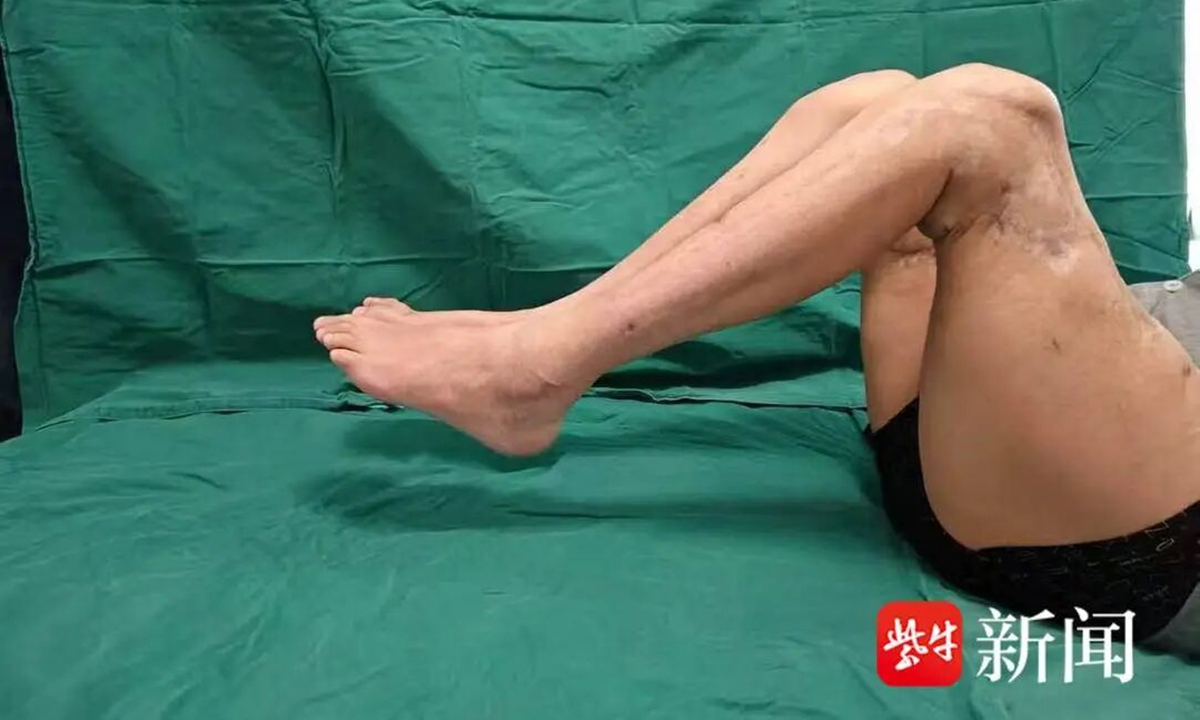
A 51-year-old patient surnamed Jiang raises his legs after more than a year of treatment following an eight-hour operation at Suzhou Ruihua Orthopedic Hospital in 2024 to reattach both legs, which had been completely severed at the thighs. Photo: Yangtze Evening PostChinese doctors have completed what they called as the world's first replantation involving the complete severing of both legs at thigh level, with the patient now able to walk indoors using a walker following a nearly eight-hour operation, according to a recent report by the Yangtze Evening Post.
The patient, a 51-year-old surnamed Jiang, had both legs completely severed at the thighs in a machinery accident at a factory on December 2, 2024. A multidisciplinary team from the trauma orthopedics and joint surgery departments at Suzhou Ruihua Orthopedic Hospital, in East China's Jiangsu Province, worked through the night for nearly eight hours to reattach the two limbs, the report said.
Li Changsong, head of a trauma orthopedics team at the hospital, told the Yangtze Evening Post on Tuesday that Jiang can now walk indoors with a walker and manage most daily activities without assistance. Sensation in his lower limbs has also recovered to the area above his ankles.
"He is still recovering and is expected to gradually stop using crutches and eventually walk independently," Li was quoted as saying by the Yangtze Evening Post on Wednesday.
In March last year, shortly after the external fixators were removed from both legs, Jiang could already lift his legs freely while lying in bed. Sensation had returned as far down as the middle of his lower legs, and he was discharged from the hospital on March 5. His main goal at the time was to stand and walk again through rehabilitation, according to the report.
More than a year later, Jiang has moved from being confined to bed to lifting his legs and then standing and walking, the report said, noting that his rehabilitation is still ongoing.
The recovery process has not been without complications. Jiang developed localized skin necrosis after the operation and underwent flap reconstruction surgeries. He later required bone grafting and reinforced internal fixation of both femurs after severe open comminuted fractures resulted in femoral nonunion.
Li said Jiang is now in good overall condition, with his legs approximately equal in length.
"A novelty assessment conducted by the Jiangsu Institute of Medical Information confirmed this as the world's first case of replantation following the complete severing of both thighs," Li said.
Li said the case was considered a world first primarily because both legs were completely severed at thigh level simultaneously, an extremely rare injury. The hospital had previously accumulated extensive experience in replanting single limbs and lower legs, while its expertise in fracture fixation, vascular anastomosis and nerve repair provided an important technical foundation for the operation, according to the report.
Li did not give a timetable for when Jiang might be able to stop using a walker completely.
"Recovery varies from person to person. We still need to monitor his muscle strength, nerve sensation and fracture healing," Li said. Based on his current progress, however, Jiang's walking ability could continue to improve, the Yangtze Evening Post reported.
Global Times
。
Current article:http://www.roubutianquegumaigoubingdian.cyou/3vupodk/ryg7.docx
Published on:16:31:21