伐木累
Sunak Vows ‘Radical’ Income Tax Cut as Truss Team Accuses Ex-Chancellor of ‘Another U-Turn’_我的网站

一 |

The view of Kolkata, India Photo: VCG
China and India have considerable scope for cooperation in the field of artificial intelligence (AI), as their AI capabilities are complementary in many respects, a senior Indian investor told the Global Times in an exclusive interview.
There is considerable scope for AI cooperation in areas that address common global challenges, including healthcare, education, agriculture, climate resilience, industrial productivity and scientific research, always within the policy frameworks established by the respective governments and international perspectives on responsible and secure AI, Mahendra Swarup, founder of VG Capital and former president of the Indian Venture and Alternate Capital Association, told the Global Times on Wednesday.
AI is likely to become one of the defining technologies of this century. India's strengths lie in software development, engineering talent, digital public infrastructure and entrepreneurial innovation. China has developed significant capabilities in AI applications, hardware, manufacturing and large-scale deployment. "These capabilities are complementary in many respects," Swarup said.
The veteran on the front line of India's venture capital investment sector made the remarks amid improving bilateral ties and a certain level of liberalization of Chinese investments in India.
Chinese investors have historically contributed to the growth of several successful Indian companies, especially start-ups. While investment activity has been moderated by regulatory developments over the past few years, there has always been underlying interest in the Indian market because of its long-term fundamentals, Swarup said.
"If the recent improvement in bilateral relations leads to greater regulatory clarity and business confidence, the Chinese investors will once again evaluate opportunities in India, although the general sentiment is one of cautious optimism," said Swarup.
Amid positive momentum in bilateral relations, Swarup noted rising opportunities for entrepreneurs from the two countries to engage in practical cooperation.
There are several areas where entrepreneurs from India and China could potentially complement each other's strengths, subject to the regulatory frameworks of different sectors in both countries, the investor said, highlighting areas including healthcare technologies, clean energy, electric mobility, advanced manufacturing, climate technologies, industrial automation, logistics and supply-chain innovation.
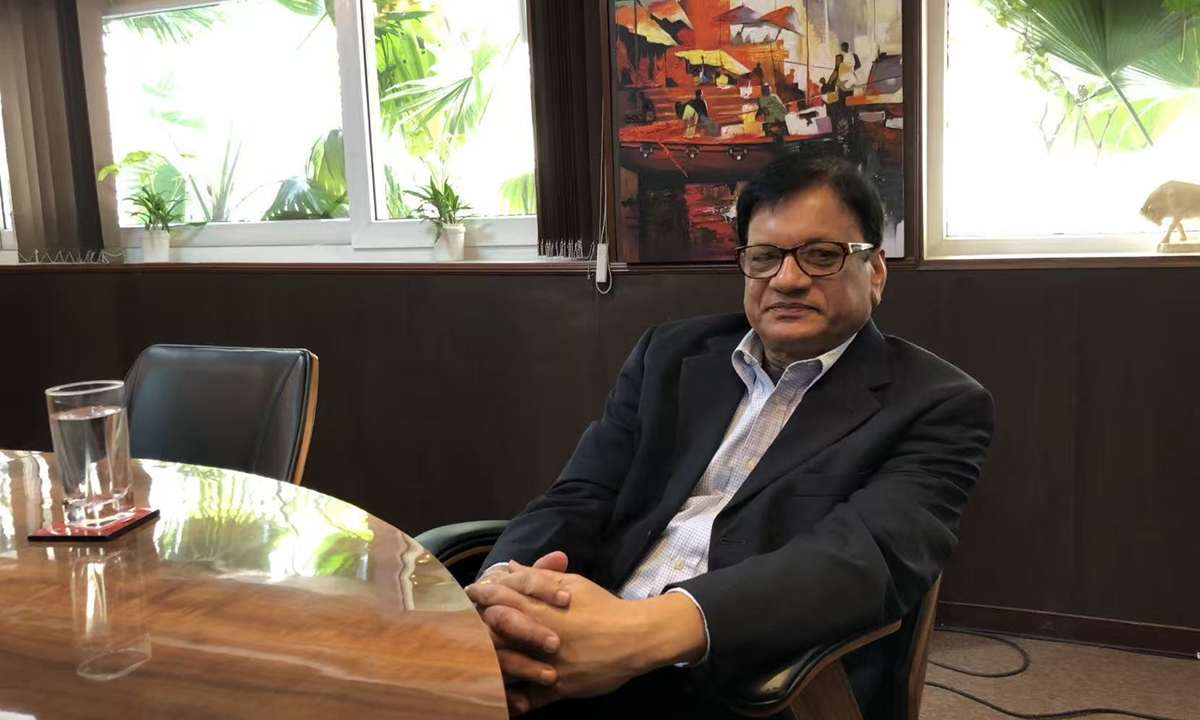
Mahendra Swarup Photo: Chu Daye/GT
"In whichever sector the complementary strengths of both China and India can be brought together responsibly, they can create value not only for both countries but also for global markets," said Swarup.
India has recently shown signs of easing some long-standing restrictions on trade and investment with China, with Chinese experts saying that the move reflects the country's growing recognition of China's importance to its economic development, and a desire to create a more favorable environment for improving bilateral ties.
There has been a gradual policy adjustment, including easing restrictions on foreign direct investment (FDI) in e-commerce, allowing FDI from companies with Chinese ownership, The Hindu reported on August 1.
With India set to host a BRICS summit this year, Swarup also said that Indian and Chinese companies can work together to promote the interests of developing countries.
India and China are both major economies with significant experience in addressing the challenges of development at scale. Although each country has followed its own development path, there are areas where companies from both nations can contribute meaningfully to broader development across Asia, Africa and other emerging markets, Swarup noted.
There is considerable potential for collaboration in affordable healthcare, digital financial inclusion, renewable energy, agricultural technologies, education technology, infrastructure, supply-chain development and support for small and medium-sized enterprises. These are areas where scalable and affordable solutions can have a significant impact on improving livelihoods, the veteran said.
Partnerships that combine technology, entrepreneurship and long-term investment can help create solutions that are both commercially sustainable and socially impactful. "As two of the largest economies in the Global South, India and China have the opportunity to contribute positively to sustainable development through innovation, responsible investment and constructive commercial engagement," Swarup said.
。 With a Tory leadership contest in full swing, former Chancellor Rishi Sunak has pledged to slash the basic rate of income tax by 20% by 2029 if he becomes UK prime minister, the largest such reduction in 30 years.,“What I’m putting to people today is a vision to deliver the biggest income tax cut since Margaret Thatcher’s government. It is a radical vision but also a realistic one, and there are some core principles that I’m simply not prepared to compromise on, whatever the prize,” Sunak emphasized.,Thatcher was Prime Minister of the UK from 1979 to 1990.,The ex-Chancellor also promised that if he prevails in the Tory leadership race, he will “never get taxes down in a way that just puts inflation up.” The 42-year-old added that he will “never make promises” he “can’t pay for” and he will “always be honest about the challenges” Britain faces.,Rishi Sunak Seeks to Crack Down on Foreign Lawbreakers, Increase Number of Deportations29 July, 09:11 GMT,“Because winning this leadership contest without levelling with people about what lies ahead would not only be dishonest – it would be an act of self-sabotage that condemns us to defeat at the next general election,” Sunak pointed out.,The Daily Mail cited an unnamed source from Foreign Secretary Liz Truss’s Tory leadership campaign as accusing Sunak of offering ‘jam tomorrow’.,“It’s welcome that Rishi has performed another U-turn on cutting tax, it’s only a shame he didn’t do this as chancellor when he repeatedly raised taxes. The public and Conservative Party members can see through these flip-flops,” the source argued.,This was echoed by Simon Clarke, chief secretary to the Treasury, who underscored that they “cannot afford to wait to help families, they need support now.” He made it clear that “Liz will cut taxes in seven weeks, not seven years.”,Sunak and Truss repeatedly locked horns over the tax issue during live TV debates last month, with the foreign secretary, in particular, accusing the former Chancellor of raising taxes “to the highest level in 70 years,” which is “not going to drive economic growth.”,Sunak claimed that the UK’s massive tax burden was the result of the unprecedented levels of government spending aimed at keeping the national economy afloat amid the coronavirus pandemic. Truss said that no other country was raising taxes, and accused Sunak of having no clear-cut plan for economic growth.,Meanwhile, voting ballots will start landing on doorsteps of Tory members starting Monday, with many of them expected to return the papers long before the September 2 deadline.,Sunak Unveils 10-Point Border Security Plan as Truss May Turn to Foreign Policy in Fight for PM Seat24 July, 06:12 GMT,Sunak and Truss are now two remaining candidates in the race to replace Boris Johnson as Conservative Party leader and prime minister. Both secured their places in the final two in July, when Trade Minister Penny Mordaunt was knocked out in the fifth round of voting by Conservative MPs.,The two contenders are set to spend the next few weeks campaigning for the votes of about 180,000 Conservative Party members around the country, who will vote by postal or online ballot. The winner of the party leadership race, who will be announced on September 5th, is due to automatically become UK prime minister.。
Current article:http://www.roubutianquegumaigoubingdian.cyou/list_njnrn/xiiakux.docx
Published on:22:57:08






 发表于 04:16:47
 QQ好友和群
 QQ空间
QQ空间 腾讯微博
腾讯微博 腾讯朋友
腾讯朋友 收藏
收藏 支持
支持 反对
反对
 发表于 05:20:57


